POPULATION
South Korea has the world's lowest birth rate
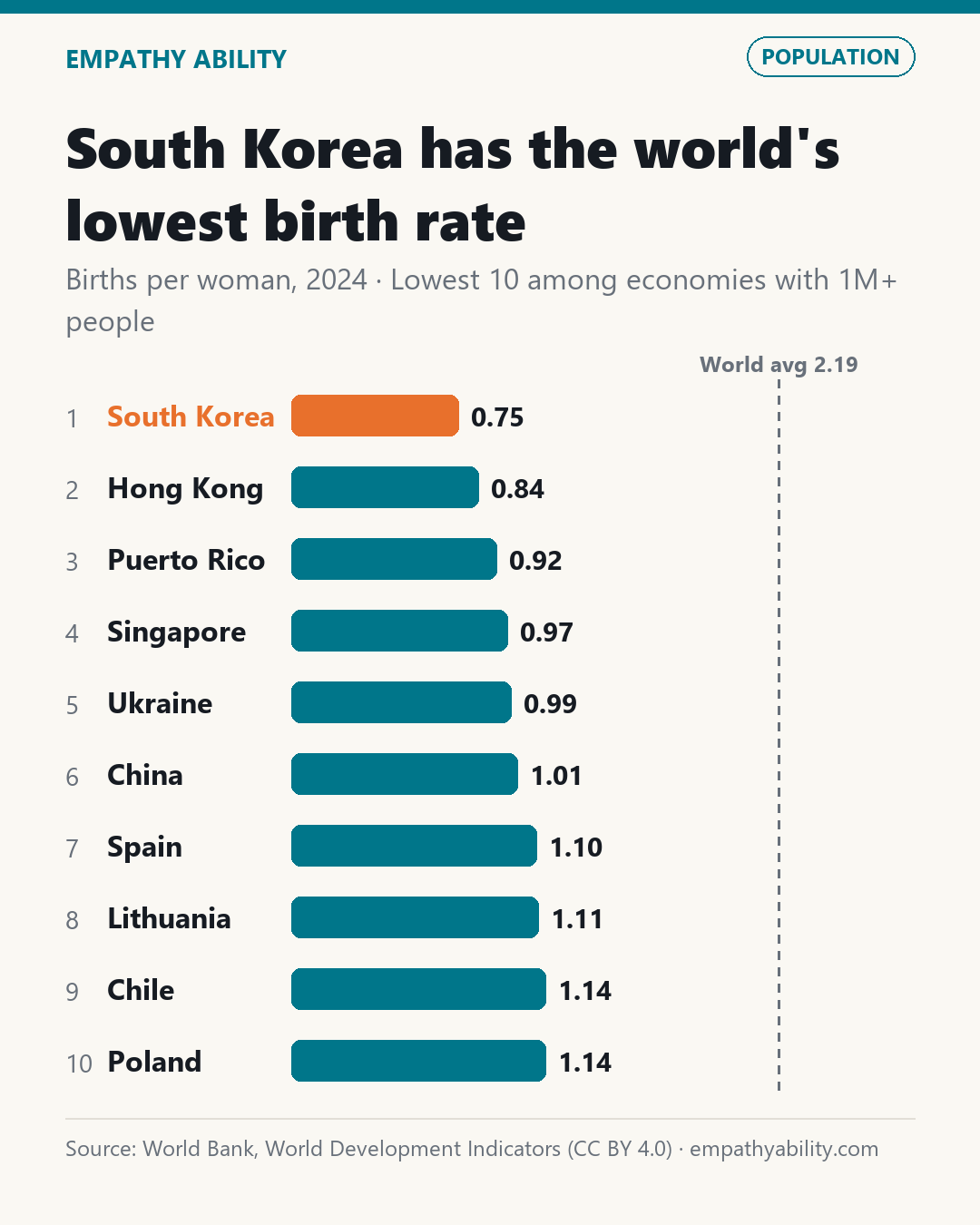
South Korea's fertility rate fell to 0.75 births per woman in 2024, the lowest of any economy with at least one million people. Here is how it compares.
The short answer
South Korea has the lowest fertility rate of any economy with more than one million people: 0.75 births per woman in 2024, according to World Bank data. Hong Kong (0.84), Puerto Rico (0.92) and Singapore (0.97) follow. The world average is 2.19.
The full top 10
| Rank | Country / economy | Births per woman |
|---|---|---|
| 1 | South Korea | 0.75 |
| 2 | Hong Kong | 0.84 |
| 3 | Puerto Rico | 0.92 |
| 4 | Singapore | 0.97 |
| 5 | Ukraine | 0.99 |
| 6 | China | 1.01 |
| 7 | Spain | 1.10 |
| 8 | Lithuania | 1.11 |
| 9 | Chile | 1.14 |
| 10 | Poland | 1.14 |
What the number means
The total fertility rate estimates how many children a woman would have over her lifetime if today's birth rates at each age stayed the same. In countries with low child mortality, about 2.1 births per woman keeps a population stable in the long run without migration.
At 0.75, each new generation in South Korea would be only about a third the size of its parents' generation.
Where the lowest rates are
Four of the ten lowest rates are in East Asia (South Korea, Hong Kong, Singapore and China) and four are in Europe (Ukraine, Spain, Lithuania and Poland). Puerto Rico and Chile complete the list. Every economy in the bottom ten is below 1.2 births per woman.
Why it matters
Very low fertility changes a country slowly but deeply: fewer children today means fewer workers and taxpayers in twenty years, more pressure on pensions and health care, and schools and universities with shrinking enrolment. Studies commonly point to housing and education costs, long working hours and later marriage as factors, and several governments on this list have introduced cash incentives. None of these economies is close to the replacement level.
How we made this
Data: World Bank, World Development Indicators (indicator SP.DYN.TFRT.IN), latest available year (2024). We compare economies with at least one million people so very small territories do not dominate the ranking; 'economies' include territories such as Hong Kong SAR and Puerto Rico.
Frequently asked questions
What is a normal fertility rate?
About 2.1 births per woman is called the replacement level in countries with low child mortality.
Which countries have the highest fertility rates?
Among economies with at least one million people, Chad, Somalia, the Democratic Republic of the Congo and the Central African Republic are all around 6.0 births per woman (2024).